Best Gym Bag for Work in Australia: How to Carry Gym Gear and Work Essentials in One Bag
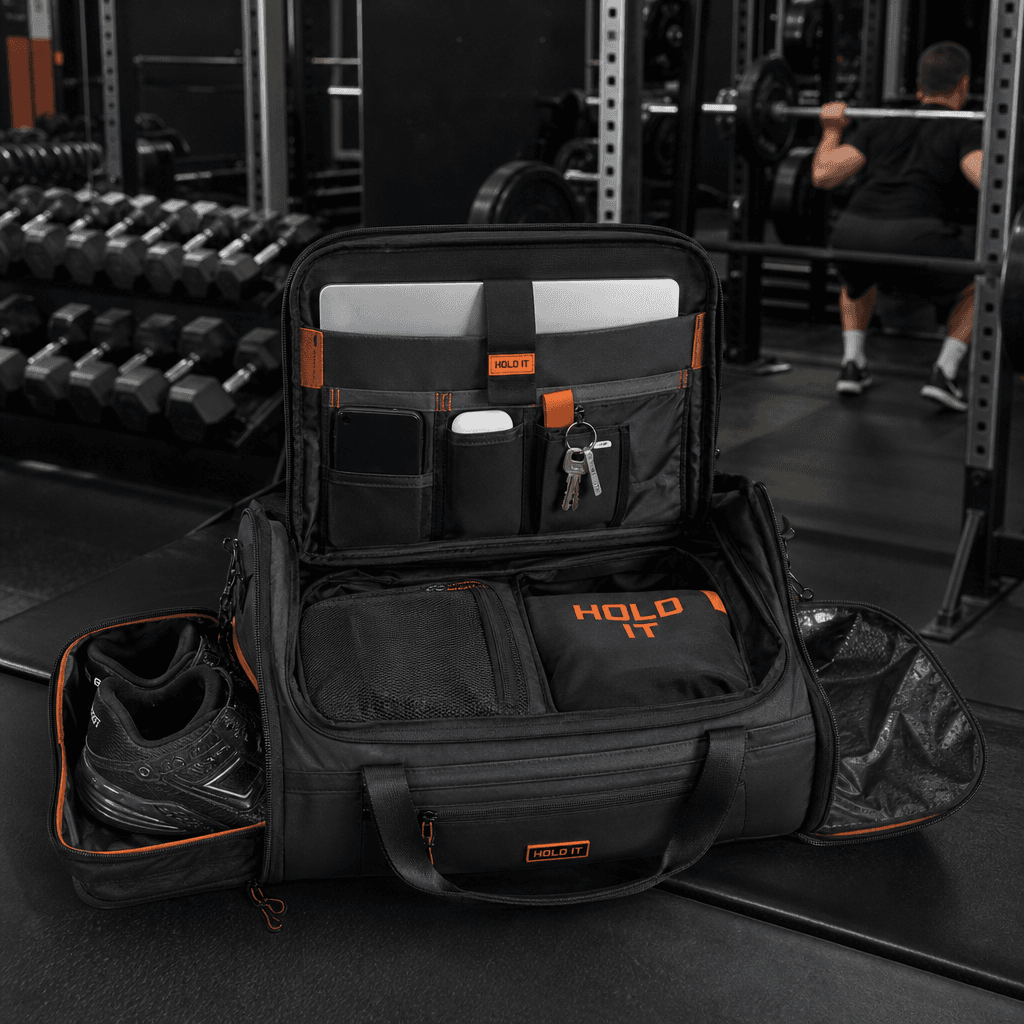
Over 60% of Australian gym members train either before work, at lunch, or straight after clocking off. That means millions of people are attempting the same logistical puzzle every single day: how do you carry a laptop, a change of clothes, your training shoes, and a water bottle without looking like you raided a camping store or showing up to a client meeting smelling like a squat rack?
Most bags on the market force you to choose. Duffels are great for gear but hopeless for laptops. Backpacks protect your work gear but compress your clean shirt into a wrinkled mess. Tote bags handle neither particularly well. The result is that a huge number of gym-going professionals in Australia end up either skipping sessions because it is too complicated, or arriving at work underprepared because they prioritised their training kit.
This guide breaks down exactly what to look for in a gym-to-work bag, how to pack one properly, and why purpose-built beats adapted every single time. By the end, you will know how to stop carrying two bags, stop compromising your training, and stop apologising for the smell.
Key Takeaways
- Look for wet/dry separation, a dedicated laptop sleeve, a shoe compartment, and quick-access pockets as your non-negotiables
- Compartmentalisation is the single biggest factor separating a bag that works from one that does not
- Most duffels and backpacks fail the work test because they were never designed for dual use
- Keeping your gear off the floor and within arm's reach during your session is just as important as how you transport it
- The right gym-to-work bag removes friction from your entire day, not just your commute
- HoldIT Bag is built specifically to solve the dual-use problem that general-purpose bags cannot
Gym Bag vs Commuter Bag: How the Options Stack Up
| Bag Type | Laptop Protection | Wet/Dry Separation | Shoe Storage | Professional Appearance | Floor-Free Storage | Overall Commuter Score |
|---|---|---|---|---|---|---|
| Standard Duffel | Poor | Rare | Sometimes | Low | No | 2/10 |
| Gym Backpack | Moderate | Rare | No | Moderate | No | 4/10 |
| Work Backpack | Good | No | No | High | No | 4/10 |
| Hybrid Commuter Bag | Good | Sometimes | Sometimes | Moderate | No | 6/10 |
| Purpose-Built Gym-to-Work Bag | Good | Yes | Yes | High | Optional Add-on | 9/10 |
The Australian Commuter-Gym Problem
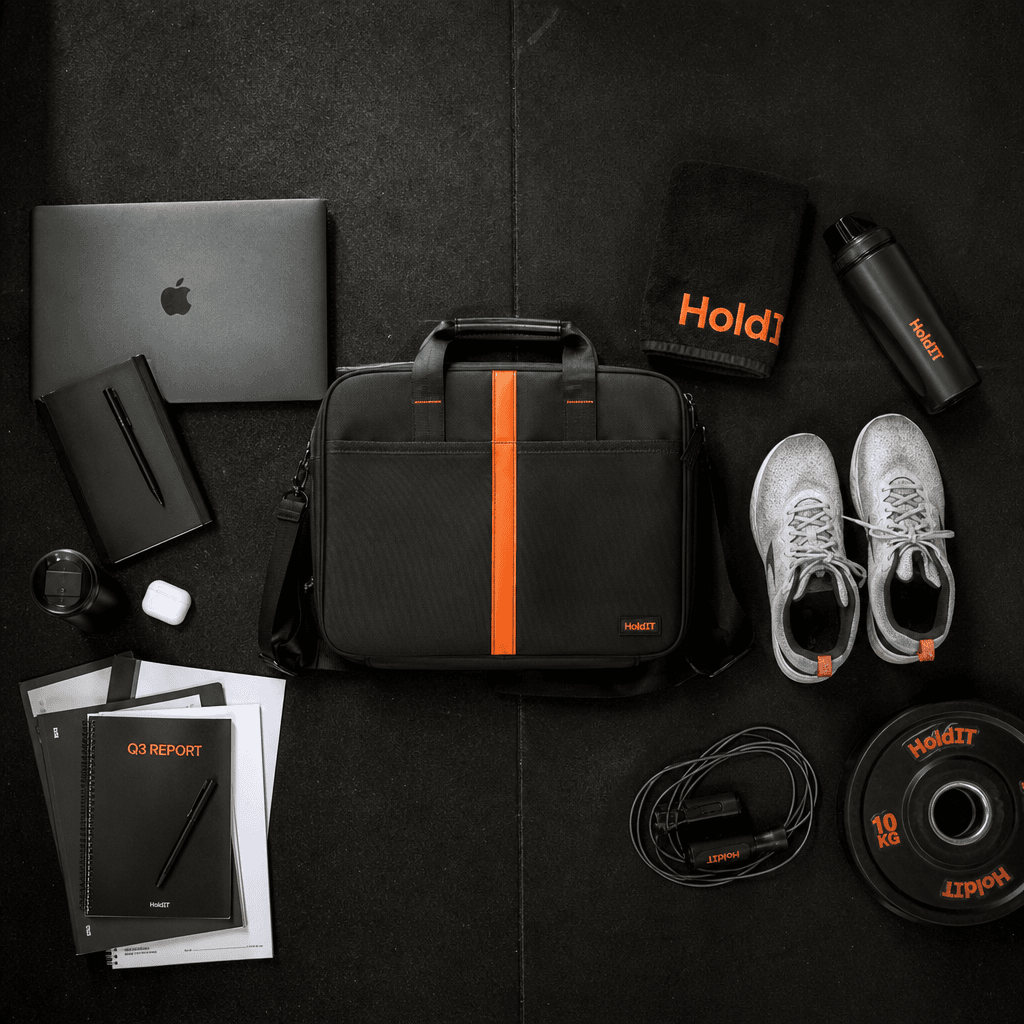
Fitness Australia's participation data consistently shows that early morning and post-work sessions account for the majority of gym visits across the country. With Australian Bureau of Statistics data pointing to over 70% of employed Australians commuting to work on at least some days, the overlap between gym-goer and commuter is massive. These are not weekend warriors. These are people who train four to five times per week and need their kit to work for a full professional day, not just the 60 minutes they spend lifting.
The problem is real and it is daily. I have spoken to hundreds of people in the HoldIT community, which now sits at over 10,000 members, and the same frustrations come up constantly. Wet towels bleeding through bags and onto laptops. Clean shirts creased beyond saving from being jammed next to a foam roller. Shoes dumped loose in the main compartment spreading dirt and rubber dust over everything else. These are not minor inconveniences. They are friction points that make people less likely to train consistently.
Roy Morgan research on Australian commuter behaviour highlights that the average commute is between 30 and 60 minutes each way in metro areas like Sydney, Melbourne, and Brisbane. That is a significant block of time where your bag is your entire life support system. It needs to do the job of a work bag and a gym bag without compromising on either.
The other dimension of this problem that rarely gets discussed is what happens to your gear once you actually get to the gym. Most bags end up on the floor. That floor is high-traffic, shared by dozens of people, and cleaned with varying degrees of regularity. I used to watch people balance their bags on a bench to avoid the floor, only to have the bag slide off mid-set and scatter everything. I have done it myself. It is a genuine interruption to your training, and it happens because bags were designed for transport, not for training environments.
Purpose-built always beats adapted. A bag designed for how serious gym-goers actually train will outperform any general-purpose bag pressed into service at the rack. That applies equally to the commute portion of your day.
Must-Have Features in a Gym-to-Work Bag
Wet/Dry Separation
This is the non-negotiable. If your bag does not have a separate, sealed compartment for wet or sweaty gear, everything else becomes irrelevant. A damp towel or a post-session shirt that has not fully dried will transfer moisture and odour to whatever shares the same compartment. In a work context, that means your laptop, your documents, your clean change of clothes, and your bag itself.
The wet/dry compartment needs to be genuinely sealed, not just a fabric divider. Look for a waterproof lining and a zip closure that runs the full length of the compartment. Half-measures here will create half the problem rather than solving it.
Dedicated Laptop Sleeve
A padded, suspended laptop sleeve is essential for anyone carrying a work machine. Suspended means the sleeve does not sit flush against the base of the bag, so if you drop the bag or it takes an impact, the laptop absorbs less of the force. The sleeve should accommodate at least a 15-inch laptop without forcing the bag's zip to strain.
If the laptop sleeve is an afterthought, a thin fabric pocket with no padding pressed against the main compartment, it offers almost no real protection. Your laptop is likely worth $1,500 to $3,000 AUD. Treat it accordingly.
Shoe Compartment
Training shoes carry everything from rubber dust to chalk to the general grime of a commercial gym floor. Mixing them with your work gear is a hygiene and cleanliness problem with no good outcome. A dedicated shoe compartment, ideally ventilated to allow airflow and reduce odour buildup, keeps shoes isolated without requiring you to carry a separate shoe bag.
Ventilation in a shoe compartment also matters for the bag's longevity. Trapped moisture accelerates the breakdown of materials from the inside out.
Quick-Access Organisation
Between the commute, the session, and arriving at work, you will be reaching into your bag dozens of times. Your phone, your access card, your earphones, your keys. If these items are buried in the main compartment or require you to unpack the bag to find them, the design is working against you.
Front-facing pockets, magnetic closures, and dedicated small-item slots are what separate a well-designed bag from one that just technically fits everything. Magnetic access in particular is significantly faster than zip access for items you reach for constantly.
Professional Exterior
This one is subjective but important. A bag that looks like it belongs in a locker room will undermine the professional impression you are trying to make. Clean lines, neutral colourways, and quality hardware signal that you take your equipment seriously. It should not look like a gym bag at reception and a work bag in the lift. It should look intentional in both environments.
Capacity: Right-Sized, Not Oversized
This is where I diverge from conventional gym bag advice. Most people do not need a 40L duffel. They need their phone, keys, wallet, earphones, a water bottle, a change of clothes, their training shoes, and possibly a couple of lifting accessories. A right-sized bag for that load sits in the 20-30L range. Anything larger encourages you to fill the space with gear that adds weight and friction without adding training value.
An oversized bag also signals a lack of intention. It is the bag equivalent of showing up unprepared.
How to Pack a Gym-to-Work Bag Step by Step
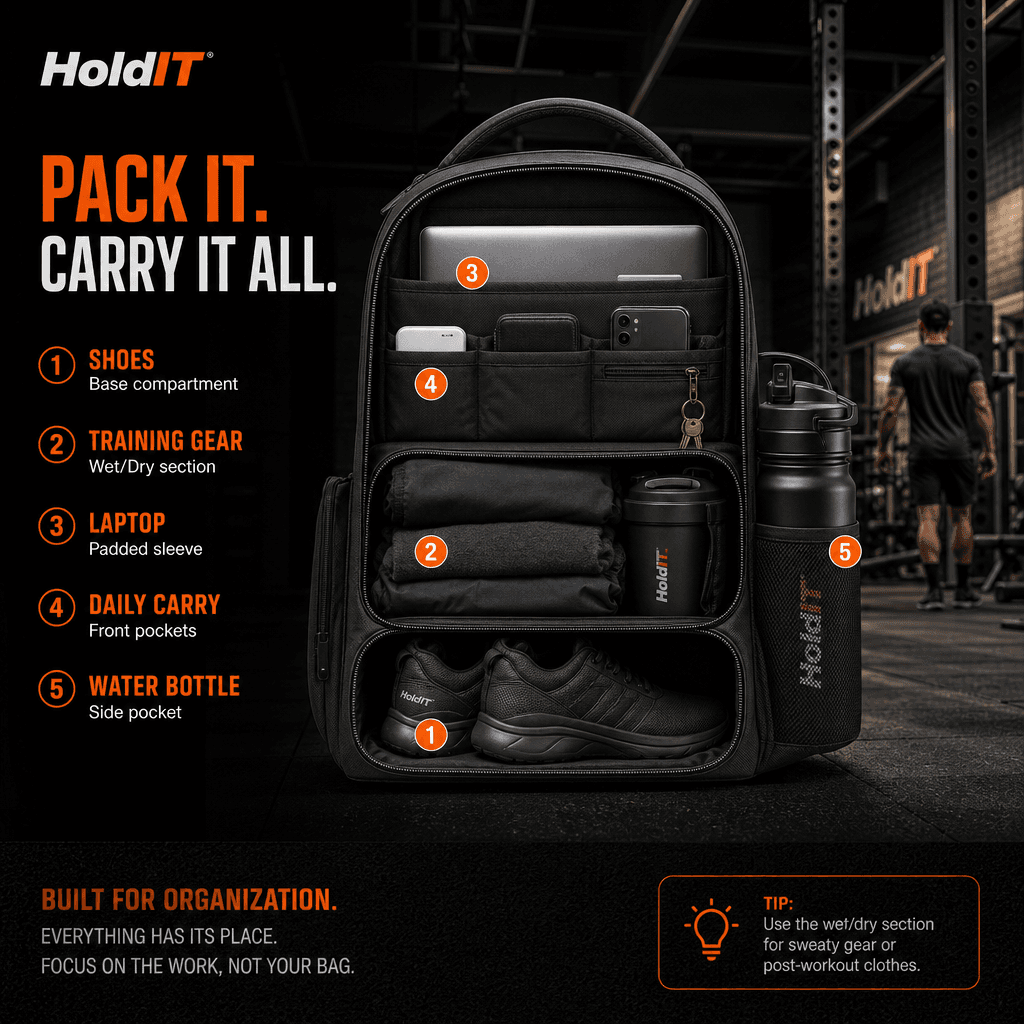
Packing order matters. A well-packed gym-to-work bag is one you can access quickly at every stage of your day without unpacking and repacking.
Step 1: Start with your shoes. If your bag has a dedicated shoe compartment, load those first. They go in last chronologically, when you change, but they go in the bag first physically to anchor the load at the base.
Step 2: Pack your training gear in the wet/dry compartment. Even if your gym clothes are clean when you leave home, designating that compartment for training gear from the start means you always know where it is and you always know where it will go after the session.
Step 3: Place your work essentials in the main compartment. Laptop in the padded sleeve, documents flat against the back panel, any additional work items on top. Think about what you will need first when you arrive at work and make sure those items are accessible without disturbing the rest.
Step 4: Use dedicated pockets for daily carry items. Phone, keys, wallet, earphones, access card. These should each have a consistent home in the bag so you are never searching for them between sets or rushing out the door.
Step 5: Water bottle last. External bottle pockets are ideal. They keep moisture away from the main compartment and are accessible without opening the bag. If your bag does not have an external bottle holder, that is a design flaw worth noting.
Step 6: After your session, reverse the clothing swap. Move your worn training gear into the wet/dry compartment immediately. Do not let it sit loose in the main compartment while you change. The system only works if you use it consistently.
Common Mistakes When Using a Gym Bag for Work
Mistake 1: Using the Main Compartment as a Dumping Ground
This is the number one reason bags fail the dual-use test. If everything goes in the main compartment because the bag lacks structure, you will spend time searching for items, your clean clothes will absorb odours from your training gear, and your laptop will share space with whatever is on the bottom of your shoes. Structure is not a luxury. It is the core function.
Mistake 2: Buying Based on Size Alone
Bigger is not better. A 40L bag that lacks a laptop sleeve and wet/dry separation is objectively worse for this use case than a 25L bag that has both. The features matter more than the volume. Most gym-to-work commuters are carrying 6-10kg of gear total. Right-size for that load.
Mistake 3: Ignoring What Happens at the Gym
The commute is only half the equation. Once you arrive at the gym, your bag needs a place to live for the duration of your session. Leaving it on the floor is a hygiene issue and a security issue. Balancing it on a bench adds clutter and creates a slide-off hazard. This is where having a solution like the HoldIT Grip system becomes genuinely valuable. A magnetic bag hook that snaps onto any vertical metal surface at the rack, the cable tower, or the dumbbell frame keeps your gear elevated and within arm's reach between sets without relying on whatever infrastructure the gym has installed.
I have been using a magnetic hook system at my regular sessions for two years. The difference in training focus is immediate and it compounds. When your phone, keys, and water bottle are at arm's reach at every station rather than in a bag on the floor three metres away, you stop wasting time and mental energy tracking your gear. I estimated early on that I was reclaiming five to ten minutes of actual productive training time per session just by eliminating that friction.
Mistake 4: Not Airing the Bag After Sessions
A gym-to-work bag that stays zipped between sessions will develop an odour problem within weeks regardless of how good the wet/dry separation is. After each session, open all compartments and allow the bag to air out somewhere with airflow. This extends the bag's life and keeps the work-facing side of its function professional.
Mistake 5: Treating the Bag Like a Floor Item at Work
At the gym, the bag needs elevation. At the office, it needs to be presentable. A bag that looks like it belongs in a locker room should not be sitting beside your desk at a client meeting. The right dual-use bag solves this because its exterior reads as intentional and professional, not as gym gear in the wrong environment.
Why Most Duffels and Backpacks Fail the Work Test
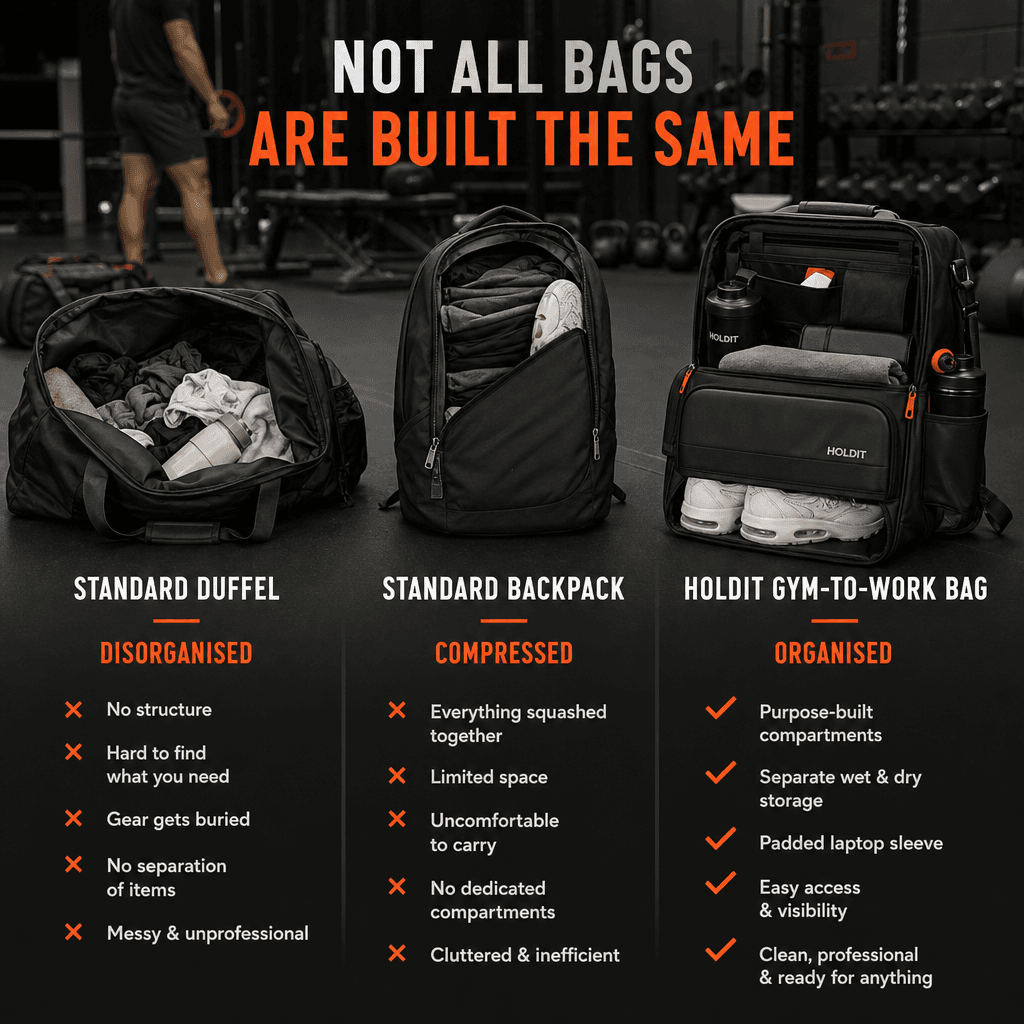
Standard duffels are built for volume, not organisation. They typically feature one large compartment, maybe a zip pocket on the exterior, and no structure at all. Everything moves freely, which means everything gets mixed together. You cannot protect a laptop in a duffel that has no padding or structure. You cannot separate wet and dry gear in a bag with one compartment. The convenience of a duffel ends at the gym entrance.
Standard backpacks are the opposite problem. They protect your work gear well because they are designed around it. But the narrow, rectangular form factor is poorly suited to gym gear. Shoes either do not fit or deform the bag. Bulky training gear compresses into the space your back occupies and creates a lumpy, uncomfortable carry. Most gym backpacks that claim dual-use functionality sacrifice the laptop protection to accommodate the gym gear, or sacrifice the gym functionality to maintain the profile of a work bag. Neither compromise is acceptable for daily use.
The fundamental issue is that both categories were designed for a single primary purpose and retrofitted for the other. A floor bag, regardless of brand or quality, does not solve the core problems serious lifters face: floor hygiene, bench clutter, and phone safety between sets. Purpose-built always beats adapted. That is not a marketing claim. It is a design reality.
A bag designed from the ground up for gym-to-work commuting starts with the constraints of both environments and works backwards to the form factor. The result looks different from both a standard duffel and a standard backpack because it has to.
How HoldIT Bag Bridges the Gap
HoldIT Bag was built around a specific brief: solve the dual-use problem that general-purpose bags cannot. The design starts with the separation of wet and dry gear, moves through a padded laptop sleeve capable of handling a 15-inch machine, incorporates a ventilated shoe compartment, and finishes with fast-access organisation for daily carry items.
The exterior is clean and professional. It does not announce itself as gym gear in a work environment. It reads as an intentional, well-considered piece of kit.
Beyond the bag itself, the HoldIT Grip magnetic hook addresses the in-gym problem that no bag alone can solve. Rated to hold up to 4kg of load, it snaps onto any vertical metal surface at your station and keeps your bag elevated, secure, and within arm's reach throughout your session. One hook covers every station in your session because it is portable. No fixed infrastructure required. No asking gym management for permission.
A member of the HoldIT community used to train at a commercial facility that had no dedicated bag hooks near the free weights area. Bags piled along the walls, created trip hazards, and cluttered the floor around the dumbbell rack. They started clipping the HoldIT hook onto rack uprights, cable towers, and dumbbell rack frames. Their gear stayed off the floor across every zone of the gym without depending on what the facility had installed. The portability meant one hook covered an entire session's worth of stations.
With 4.8 out of 5 stars across 895 verified reviews, the feedback from people who have made the switch is consistent: the system works, and it earns a permanent spot in your kit.
If you are ready to stop choosing between a gym bag and a work bag, visit the HoldIT shop and find the setup that fits your training. If you have questions, we will sort it. Everything is dispatched from Sydney within 48 hours.
What to Look for When Buying: A Feature Checklist
Use this when evaluating any bag for gym-to-work use:
- Sealed wet/dry compartment with waterproof lining
- Padded, suspended laptop sleeve (15-inch minimum)
- Ventilated shoe compartment
- External water bottle pocket
- Fast-access front pockets with magnetic or quick-zip closure
- Padded, adjustable straps for commuting comfort
- Professional exterior that works in an office environment
- Capacity in the 20-30L range (right-sized, not oversized)
- Durable hardware that will survive daily use
- A paired elevation solution for in-gym storage
If a bag ticks all of these, it will serve you properly. If it misses more than two, you will be compensating with workarounds within a month.
For a deeper look at the training accessories that pair well with a gym-to-work setup, the HoldIT Training Room covers the full picture.
Packing for Specific Scenarios
Early Morning Session Before Work
This is the most demanding scenario. You are carrying everything for the day, your training gear, your work gear, and your post-session fresh kit. The bag needs to handle the full load without looking dishevelled when you arrive at the office.
Pack your clean work clothes on top in the main compartment so they are accessible immediately after your session. Use the wet/dry compartment for your training gear from the moment you leave home so the system is set up before you even arrive at the gym.
Lunchtime Session
This is the lighter scenario. You are likely leaving your main work bag at your desk and taking a smaller kit to the gym. A compact carry with your training gear, your phone, and your water bottle is all you need. The focus here is speed: getting to the gym, training, changing, and returning within a tight window.
Quick-access organisation is critical here. You cannot afford to be searching for your access card or your earphones when you have 45 minutes total.
Post-Work Session Before Going Home
This is the scenario where wet/dry separation matters most. Your session is done, your gear is worn, and you are carrying everything home on the train or in the car. Wet training gear needs to be fully isolated from everything else for a journey that could be 30-60 minutes.
A quality wet/dry compartment with a proper seal is the difference between arriving home with everything intact and arriving home with a damp laptop bag that smells like a change room.
References
-
Fitness Australia Industry Participation Report, Fitness Australia's annual participation data covering gym membership patterns, session timing, and demographic breakdowns across Australian fitness facilities. The primary source for participation rates and session timing habits among Australian gym members.
-
Australian Bureau of Statistics (ABS), Work-Related Travel Data, ABS data on commuting patterns, including frequency and duration of commutes across Australian capital cities and regional centres. Used to contextualise the overlap between commuter behaviour and gym participation.
-
Roy Morgan Research, Australian Commuter Behaviour Study, Roy Morgan consumer research tracking commuter habits, commute duration, and transport mode preferences across Australian metro and regional populations.
-
Fitness Australia, State of the Fitness Industry Report, Broader industry data on gym-going frequency, membership growth, and consumer behaviour in the Australian fitness market. Referenced for context on training frequency among regular gym members.
-
Australian Competition and Consumer Commission (ACCC), Product Standards Reference, ACCC guidelines relevant to consumer product quality claims and warranty obligations in the Australian market, providing context for product quality standards and consumer protections.
Get exclusive training tips & early access
Join 5,000+ athletes who train smarter.
Frequently Asked Questions
Can I fit a laptop in a gym bag?
Yes, but only if the bag was designed with a dedicated, padded laptop sleeve. A standard gym bag with a main compartment and no structure offers no meaningful protection for a laptop. Look for a suspended sleeve with padding on all sides, rated for at least a 15-inch machine. The sleeve should be separate from the main compartment rather than sharing space with your training gear.
How do I stop gym clothes from smelling at work?
The most effective solution is wet/dry separation. A bag with a sealed, waterproof-lined compartment for your worn training gear will contain odours so they do not transfer to your work clothes or your bag's interior. Beyond that, move worn gear into the wet/dry compartment immediately after changing rather than leaving it loose. Air your bag out after every session. Use a training-specific detergent for your gym clothes and wash them promptly after each use.
What size gym bag is best for commuting?
For most gym-to-work commuters, the 20-30L range is optimal. This is enough capacity for a laptop, a change of clothes, training shoes, a water bottle, and daily carry items without creating an oversized, unwieldy carry. Bags larger than 35L encourage packing gear you do not need and become physically awkward on public transport or in tight office environments.
Is a backpack or duffel better for gym and work?
Neither category performs well at the dual-use task without significant compromise. Standard duffels lack the structure and laptop protection required for work. Standard backpacks lack the compartmentalisation and capacity required for gym gear. A purpose-built gym-to-work bag is a third category designed from the ground up for both environments. If you are choosing between a duffel and a backpack, a backpack is the lesser-bad option because it protects your work gear better, but it is still a compromise.
How do I keep my gym gear organised during a session?
This is a separate problem from commuter organisation. A bag is a transport solution, not a storage solution at the rack. A magnetic bag hook that attaches to a vertical metal surface at your station keeps your bag elevated, within arm's reach, and secure between sets without relying on the gym's infrastructure. It also keeps the bench clear and your gear off the floor.
What should I always have in my gym-to-work bag?
The core list is: phone, keys, wallet, earphones, water bottle, training shoes (in their compartment), worn-gear bag or wet compartment, laptop (in its sleeve), a change of work clothes, and any training accessories specific to your programme. Everything beyond that is worth questioning. A right-sized bag packed with intent beats an oversized bag stuffed with maybe-useful gear.
Does HoldIT Bag ship across Australia?
Yes. All orders are dispatched from Sydney within 48 hours. Whether you are in a metro area or a regional location, the same processing time applies. For specific delivery queries or anything else, the support page has everything you need.
Is the HoldIT magnetic hook safe to use on gym equipment?
The magnet is rated to hold up to 4kg of load and is designed to attach to vertical metal surfaces including rack uprights, cable towers, and dumbbell rack frames. It does not require any modification to the equipment and can be repositioned throughout your session as you move between stations. It leaves no marks and requires no permission from gym management to use.
Related Articles
What Size Gym Bag Do You Need? An Australian Guide to Choosing the Right Capacity
The Best Gym Bag for Functional Fitness and CrossFit in Australia
The Best Gifts for Personal Trainers in Australia: Practical and Unique Ideas
Your gear deserves better
Keep it clean, organised, and always within reach. The HoldIt bag system is built for athletes who take training seriously.