What Size Gym Bag Do You Need? An Australian Guide to Choosing the Right Capacity
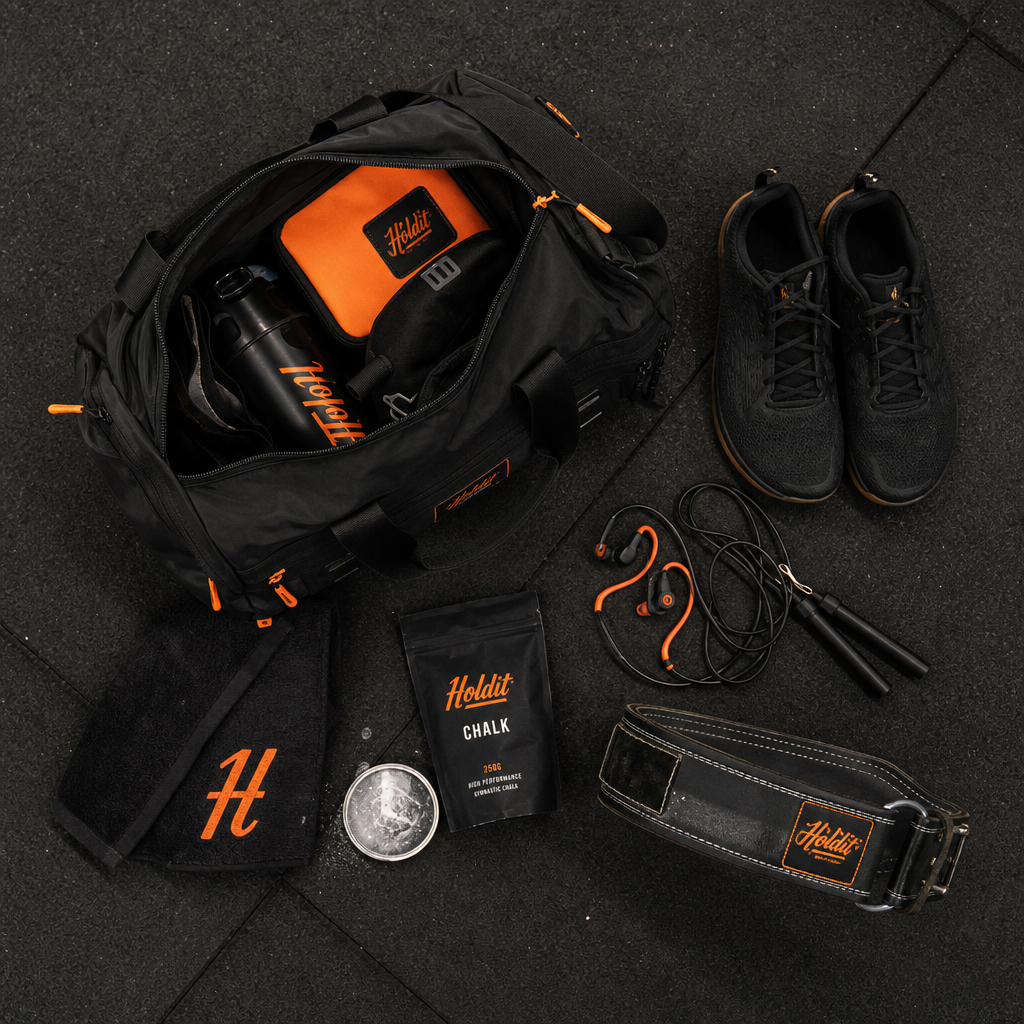
You have been there. You pack your bag the night before, get to the gym, and either you are cramming your shoes into a bag that clearly was not designed to hold them, or you are hauling a bag the size of a small suitcase just to carry your water bottle, earphones, and a change of clothes. Both are frustrating. Both are avoidable.
Choosing the right gym bag capacity is one of those decisions that sounds trivial until you get it wrong. A bag that is too small creates daily friction: gear gets left at home, things go missing between sessions, and you end up using the bench or the floor as overflow storage. A bag that is too large becomes its own problem. It encourages you to pack things you do not need, it weighs more than your actual training session warrants, and it takes up space that annoys everyone around you.
This guide cuts through the noise. I will show you exactly how gym bag capacity is measured, what size suits each type of training, the mistakes most people make when they buy, and how to match capacity to your actual weekly training load, not some hypothetical worst case. If you are an Australian gym-goer commuting by train, cycling to the gym, or squeezing a session into a workday, this is written for you.
Key Takeaways
- Gym bag capacity is measured in litres, and that number is the only reliable comparison tool across brands and styles.
- A 20-25L bag handles quick sessions with minimal gear; 30-40L covers full training kits including shoes; 40L+ is for work-to-gym commuters or swimmers.
- Most gym-goers genuinely need less space than they think. Right-sizing reduces friction, not convenience.
- Dimensions matter as much as litres when it comes to shoulder comfort, locker fit, and carrying on public transport.
- Bag organisation (pockets, compartments, wet-dry separation) reduces the effective size you need by keeping gear accessible rather than buried.
- How your bag sits during your session matters. A bag that ends up on the floor or sliding off a bench is a distraction and a hygiene problem, regardless of its size.
Gym Bag Size at a Glance: Use Case vs Recommended Capacity
| Use Case | Recommended Capacity | Typical Gear | Notes |
|---|---|---|---|
| Quick session, minimal gear | 15-20L | Phone, keys, wallet, earphones, water bottle | Fine for cardio or light lifting |
| Standard gym session | 20-25L | Above plus towel and training shoes | Most recreational gym-goers |
| Full training kit | 30-35L | All above plus gym clothes, post-workout snack | Serious lifters, class-goers |
| Swimming or sport | 35-40L | Wet gear, goggles, multiple towels, sport kit | Needs wet-dry separation |
| Work-to-gym commute | 40-50L | Laptop, work clothes, full gym kit | Heavy; consider a structured bag |
| Travel and gym combined | 50L+ | Overnight gear plus training kit | Verges on carry-on luggage |
How Gym Bag Size Is Measured: Litres vs Dimensions
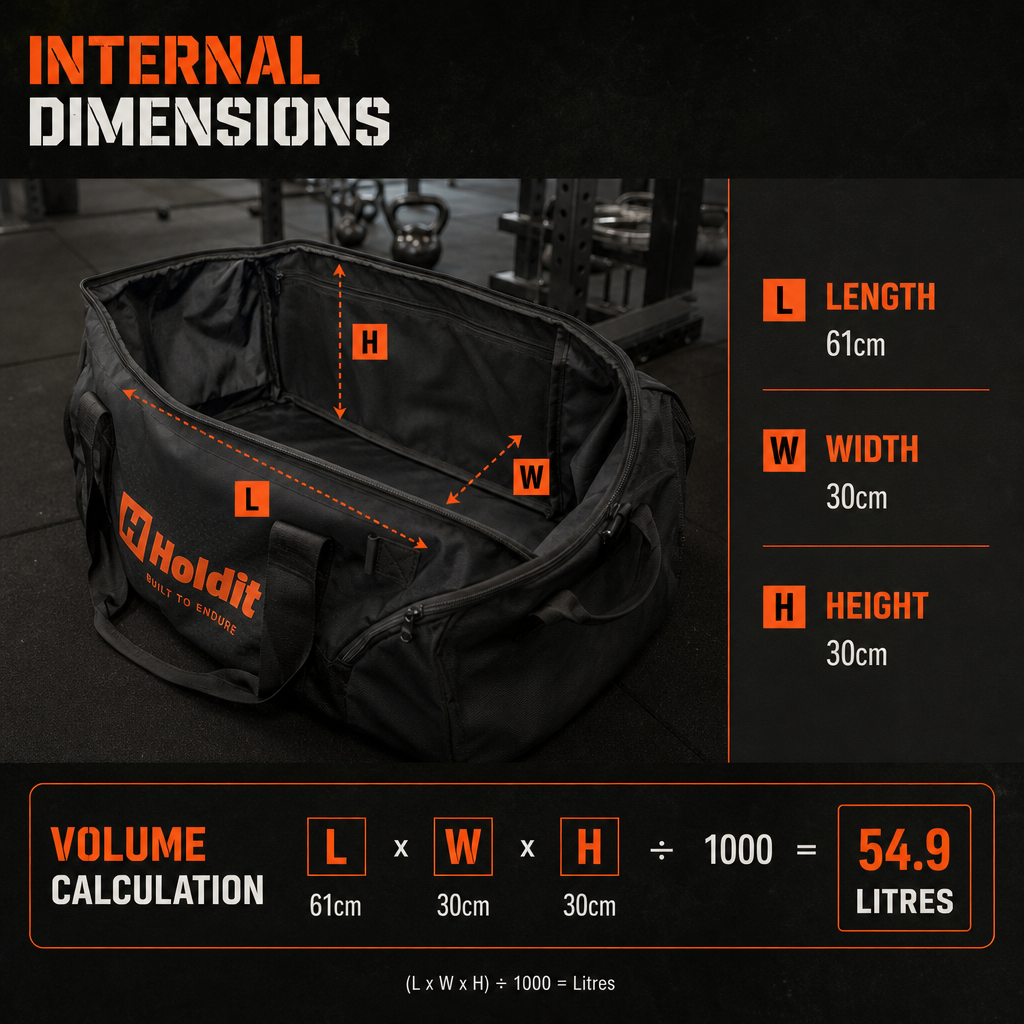
Let's get the basics sorted. When a brand says a bag is "30 litres," they are describing its total internal volume. That number is calculated by multiplying the internal length, width, and height in centimetres and dividing by 1,000. So a bag that measures 45cm x 28cm x 24cm internally has a volume of roughly 30.2 litres.
Here is the catch: not all brands measure the same way. Some include every external pocket in the total. Others measure at the bag's widest point, which artificially inflates the number. A 30L bag from one brand can feel noticeably smaller than a 30L bag from another if the internal structure is different.
This is why dimensions (length x width x height) are just as important as the litre figure. Always check both.
Why Litres Became the Standard
Litres took over from vague size labels like "small," "medium," and "large" because they give you a consistent, testable number. When you are comparing a duffel to a backpack-style gym bag, litres let you make a direct comparison even though the shapes are completely different.
The litre measurement also helps you plan. If you know your training shoes take up about 5-6 litres of space, a water bottle takes around 1.5 litres, and a change of clothes takes 8-10 litres, you can work backwards to figure out the minimum bag you actually need.
Dimensions and Why They Matter Beyond Volume
A bag might be 35 litres but shaped like a long, narrow tube. That works for a cricket kit bag. It does not work for an inner-city commuter trying to fit the bag in an overhead locker on a Sydney train.
For Australian commuters, the practical dimensions to think about are:
- Locker fit: Most commercial gym lockers in Australia run approximately 30cm wide x 30cm deep x 60cm tall. A duffel that is 55cm long but only 25cm wide will not stand upright. It needs to be laid flat, which means it takes up a full locker and might still not close.
- Train and bus carry: Anything over about 45cm in any single dimension becomes awkward on crowded peak-hour services in Sydney, Melbourne, or Brisbane. Width is the real constraint.
- Weight when loaded: Dimensions tell you nothing about weight. A structured 35L bag with metal hardware can weigh 1.2kg empty. A lightweight 35L nylon duffel might weigh 400g. When you are commuting by foot or public transport, that difference matters across a week of sessions.
The Gear-First Method for Calculating Your Ideal Size
Rather than starting with a litre number and hoping for the best, start with your actual gear. Lay everything you typically bring to the gym on a flat surface. Not your aspirational kit. Your actual kit, the stuff that goes in your bag every single session.
For most gym members, that list looks something like this:
- Training shoes (approximately 5-6L)
- Change of clothes, top and shorts or tights (approximately 5-7L)
- Towel, medium sized (approximately 3-4L)
- Water bottle, 750ml to 1L (approximately 1.5L)
- Phone, keys, wallet, earphones (approximately 1L)
- Lifting accessories: belt, wraps, gloves if you use them (approximately 3-5L)
That is a conservative 19-24 litres for a well-equipped recreational lifter. Add post-workout protein, a second top, or a laptop and you push toward 30-35L. That is the genuine calculation. It almost never comes out above 40L unless you are a swimmer, a martial artist with a gi, or you are going straight from the gym to a work event.
Matching Gym Bag Size to Your Training Style
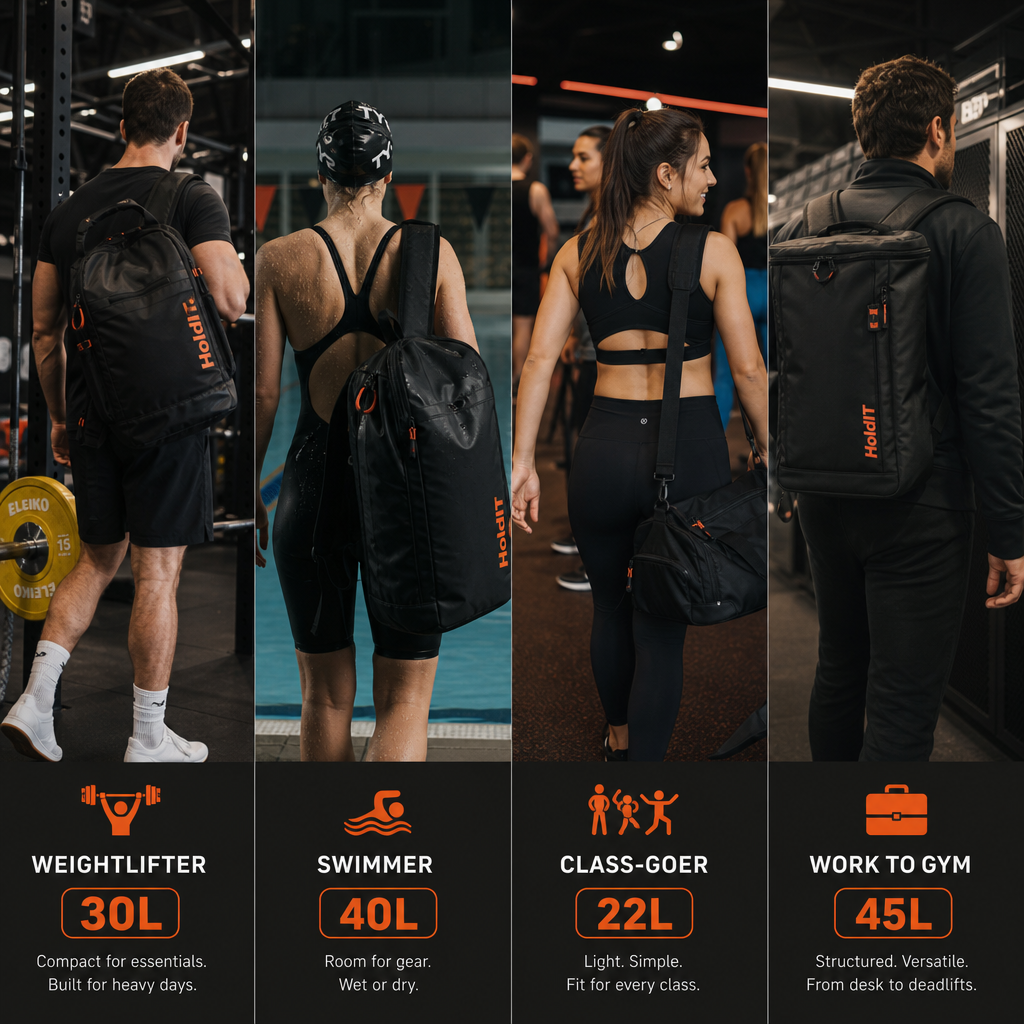
The single biggest mistake people make is buying a gym bag for the type of training they imagine they might do, rather than the training they actually do. Let's go through each training style and the honest capacity that fits it.
Weightlifting and Powerlifting: 25-35L
Serious lifters think they need big bags. They usually do not. The extra kit that lifters carry, chalk, a belt, knee sleeves, wrist wraps, and maybe lifting shoes, adds up to about 6-8 litres beyond a standard gym kit. That puts most well-equipped lifters comfortably in the 30-35L range.
The bigger priority for lifting is not size, it is compartmentalisation. Your chalk bag needs to be isolated so it does not coat everything else. Your belt should not be stuffed around your shoes. A well-organised 30L bag beats a disorganised 40L bag every single time.
One thing I see constantly at commercial gyms across Australia: lifters pack enormous bags, leave them on the floor next to the squat rack, and then spend half their rest periods rummaging around looking for their phone or their wraps. The bag is too big, nothing has a fixed place, and every set ends with a gear hunt.
I ran into this myself. I was training 4-5 sessions a week, and my bag was permanently on the floor. Keys, phone, wraps: all buried. I was losing 5-10 minutes of focus per session just managing the bag. The fix was not a different bag size. It was getting the bag off the floor entirely. Once I started snapping the HoldIt hook onto the squat rack upright, everything sat at arm's reach between sets, and I stopped losing track of anything. The bag sorted itself because I could actually see into it.
Group Fitness and Yoga: 20-25L
Pilates, yoga, HIIT classes, boxing: these all require less specialised kit than lifting, but they often require a change of clothes post-session because class-goers are more likely to be heading somewhere afterwards. A 20-25L bag is almost always sufficient here. The key features to prioritise are a separate shoe compartment (to keep your mat or studio shoes away from street shoes) and a wet pocket for a damp towel.
Swimming and Aquatic Training: 35-45L
Swimming is the use case that genuinely justifies a larger bag. Wet gear is bulky. Two towels, a wet swimsuit, goggles, a cap, and potentially a kickboard or fins push the volume requirement up significantly. Add a change of clothes and shower kit and you are looking at 35-40L minimum.
For swimmers, wet-dry separation is non-negotiable. A bag without a dedicated wet compartment means wet gear soaks everything else. Look for a bag with a waterproof-lined base or a sealed wet pocket that holds at least 8-10L on its own.
Work-to-Gym Commuters: 40-50L
This is the trickiest use case because you are effectively packing two separate loads into one bag: a work kit and a gym kit. A laptop, charger, work documents or notebook, work shoes, and dress clothes will use 20-25L on their own. Add your gym kit and you are at 35-40L before any extras.
For this use case, structure matters as much as size. You need clear separation between the work section and the gym section so you are not pulling sweaty training gear out past your laptop every morning. A bag designed with a dedicated top-access work compartment and a lower gym compartment is the sensible approach.
I spoke to a member of our HoldIt crew recently, a guy commuting from Parramatta into the city five days a week, gym on Monday, Wednesday, and Friday mornings. He had been using a 45L duffel for over a year and hated it. Not because it was the wrong size, but because everything was mixed together. When I asked what size he thought he needed, he said "bigger." When I asked him to lay his gear out and add it up, it came to 38L. The bag was already more than enough. The problem was organisation, not capacity.
Cycling Commuters: 20-30L
If you are cycling to the gym or cycling as part of your training, size constraints become even more important. A bag that is too wide throws off your balance on the bike. A bag that is too heavy changes your posture. For cyclists, 20-28L is usually the practical ceiling, and a back-friendly carry system (either a proper backpack harness or a compact duffel that straps across the body) makes a real difference on a longer ride.
Common Sizing Mistakes Australian Gym-Goers Make
Mistake 1: Buying for the Worst-Case Session
Most people size up because they are thinking about the one session every six weeks where they bring extra gear: competition day, the session after a work function, the time they brought a foam roller. For the other 49 sessions, the bag is half-empty and awkward to carry.
Buy for your average session, not your edge case. For the rare oversized load, an extra tote bag costs $5 and solves the problem without compromising your daily carry.
Mistake 2: Ignoring Compartment Structure
A 40L bag with no compartments is less useful than a 25L bag with dedicated pockets for shoes, a wet compartment, a top-access phone pocket, and a key clip. Volume without organisation means you are digging through a pile of gear every time you need something. That friction adds up across 200+ sessions per year.
This is the "purpose-built beats adapted" principle at work. A general-purpose duffel pressed into gym service is not designed around how you actually move through a session. A bag built for training has the phone pocket where your phone naturally goes, the shoe compartment at the base so you are not stacking clothes on shoes, and the wet pocket sealed so a damp towel does not spread moisture to everything else.
Mistake 3: Not Accounting for the Locker
Australian commercial gym lockers, the standard units you find at Fitness First, Anytime Fitness, or F45 locations across the country, typically run about 30cm wide. A 55cm-long duffel laid flat is going to take up the full depth of a small locker. A 45cm bag with a structured base will stand upright and actually close the door.
Check the dimensions of your gym's lockers before you buy. Most gyms will tell you if you ask at reception. It takes 30 seconds and saves you the frustration of owning a bag that technically fits but is miserable to use in practice.
Mistake 4: Underestimating Shoe Volume
Training shoes are the single largest discrete item most gym-goers pack. A standard men's size 10 training shoe takes up roughly 2.5-3 litres per shoe: 5-6 litres per pair. A size 12 can push 7-8 litres. If the bag does not have a dedicated shoe compartment, those shoes will dominate the main cavity and crush everything else.
For this reason alone, a bag with a shoe-specific lower compartment is almost always a better choice than a slightly larger bag without one. The shoes get their own space, the rest of the bag stays usable.
Mistake 5: Treating the Gym Floor as Extra Storage
I am going to be direct here because this one bothers me. The gym floor is not a storage solution. Every serious gym-goer I know has accepted floor storage as the default because there has never been a clearly better option. But gym floors are high-traffic, often damp, and carry a real hygiene issue. A bag that sits on the floor picks up whatever is on the floor.
Sizing your bag correctly is part of this solution but it is not the whole solution. A right-sized bag that stays off the floor, within arm's reach during your session, is the full picture. That is exactly what the HoldIt hook is designed for: it snaps onto any vertical metal surface at your station, keeps the bag elevated and accessible between sets, and your bench stays clear.
I know a gym member who trained at a large commercial facility with no fixed bag hooks near the free weights. They were stacking bags on benches and along the walls, which created trip hazards and took up bench space other members needed. When they started bringing the HoldIt hook and clipping it onto cable towers and rack uprights, their gear stayed off the floor across every zone. One hook covered every station in their session. The portability meant they did not have to think about bag storage again.
How HoldIt Bag Capacity Compares
HoldIt's bags are designed around one philosophy: right-sized for real training sessions. That means the capacities in the HoldIt range reflect how actual gym-goers pack, not how a product photographer staging a flat lay packs.
The sweet spot in the HoldIt range sits between 25L and 35L, which covers the majority of gym-goers training 3-5 sessions per week with full kit. The bags are built with dedicated compartments so that the effective usable space is higher than the raw litre number suggests. A well-structured 30L bag will fit more organised gear than a poorly structured 35L bag every time.
The HoldIt bag hook integrates with the bag system to solve the floor storage problem directly. The magnet is rated to hold up to 4kg, which comfortably handles a loaded gym bag through a full session. It snaps onto any steel vertical surface: rack uprights, cable towers, dumbbell rack frames. The bag goes off the floor and within arm's reach between sets. That is the full system.
Across our community of 10,000+ members, the average verified review rating sits at 4.8 out of 5 across 895+ reviews. The most consistent feedback: people did not realise how much time and focus they were losing to bag management until they stopped losing it.
For a fuller breakdown of how HoldIt compares to other options in the Australian market, the best gym bags Australia guide covers the full field.
Carry Comfort and Weight: The Dimensions Nobody Talks About
Capacity gets all the attention. Carry comfort gets almost none. That is backwards, because a bag you hate carrying is a bag you stop using consistently, and inconsistent training gear creates inconsistent training.
Strap Design and Daily Carry
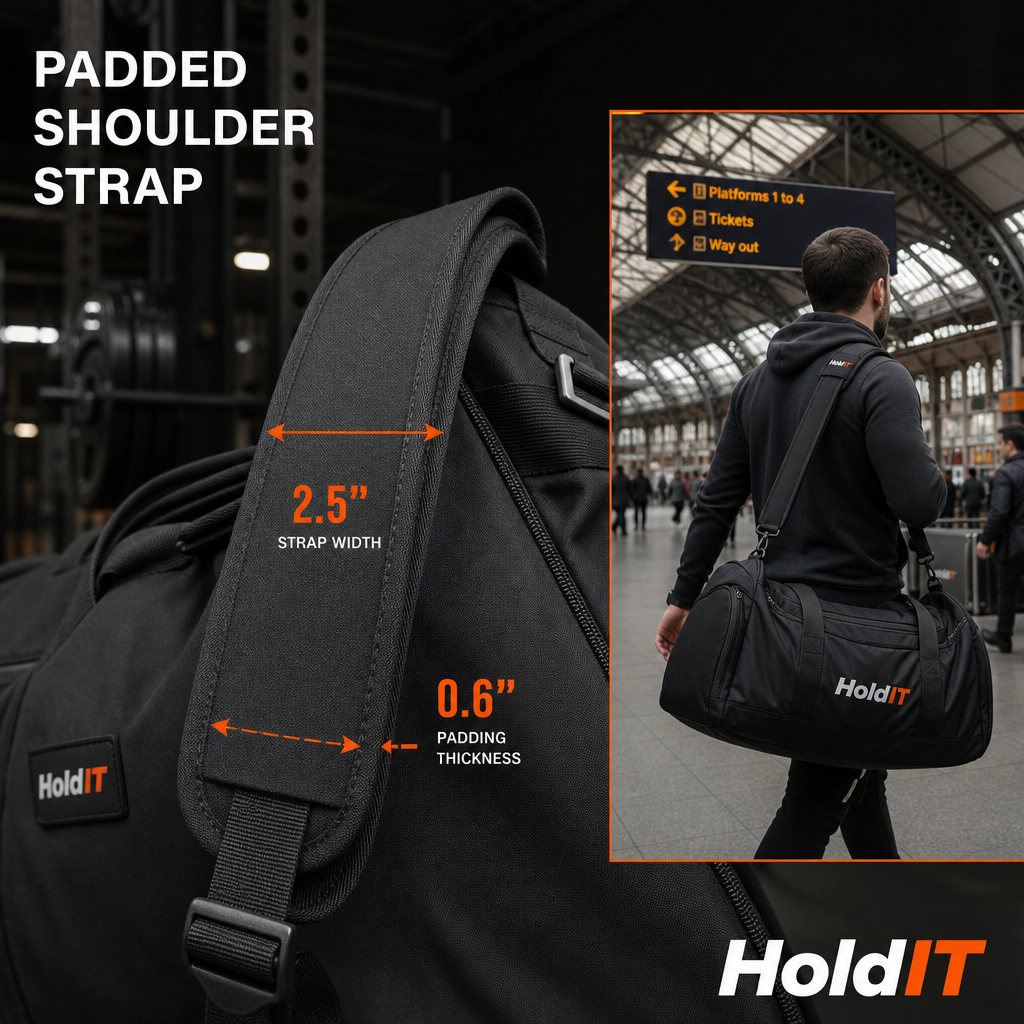
For a gym bag carried 3-5 times a week by foot, on public transport, or on a bike, the shoulder strap is not a secondary feature. It is a primary one. A single flat strap with no padding will dig into your shoulder under a 30L load within a few hundred metres. A padded, wide-profile strap distributes the weight properly and makes a genuine difference across a year of use.
If you are commuting by train in Sydney or Melbourne, the bag often goes on your back or across your body during peak hour because there is no overhead space. A duffel with a long, adjustable shoulder strap handles this much better than one with fixed handles designed for hand-carry only.
Empty Bag Weight
This is a number that almost no buyer checks but should. An empty gym bag that weighs 1.5kg is adding 1.5kg to every carry before you put a single item in it. Across 200 sessions per year, that dead weight adds up in a very real way for commuters and cyclists.
Lightweight nylon construction (look for 420D or 600D nylon) typically keeps empty bag weight under 700g for a 30L bag. Heavier canvas or waxed cotton materials add substantial tare weight. They look good. They are not the practical choice for a daily training bag.
Back Panel and Airflow
For bags worn as backpacks during a commute, the back panel design affects how much you sweat and how comfortable the carry is over distance. A stiff, structured back panel keeps the load close to your body (good for balance on a bike or when navigating crowds). A mesh panel promotes airflow. Both have a place depending on your commute.
For pure duffel carry, back panel is irrelevant. For any bag that gets strapped to your back even occasionally, it is worth checking.
The Hidden Weight: What You Pack
The bag is never the heaviest thing you carry to the gym. The gear is. A 1L water bottle weighs 1kg when full. A 13-inch laptop weighs 1.3-1.8kg. A lifting belt can weigh 1-2kg depending on the material. These items add up independently of the bag itself.
The practical implication: a right-sized bag that stops you over-packing is lighter to carry than an oversized bag that tempts you to fill it. This is the counterintuitive reason that sizing down often makes your daily training load lighter, not heavier.
Gym Bag Size Checklist: What to Do Before You Buy
Before you spend money on a gym bag, run through this checklist.
Step 1: List your actual gear. Not your aspirational gear. The stuff that goes in the bag every session. Tally the rough volume using the estimates earlier in this guide.
Step 2: Add 10-15% buffer. You will add items occasionally. Build in a small margin without defaulting to the next size up.
Step 3: Check your gym locker dimensions. Most Australian commercial gym lockers are 30cm wide. Anything longer than 45cm needs to lie flat.
Step 4: Measure your commute. If you are walking, cycling, or catching public transport, dimensions and strap design matter as much as volume.
Step 5: Count the compartments. A bag with dedicated shoe, wet, phone, and main compartments needs less raw volume than a single-cavity duffel. Factor this in.
Step 6: Weigh the empty bag. If the listed empty weight is over 1kg for a bag under 35L, ask whether the extra weight is worth whatever the material offers.
Step 7: Decide where the bag lives during your session. If the answer is "on the floor," you have not solved the storage problem yet. A right-sized bag plus a mounting solution is the full system.
Real-World Case Studies
Case Study 1: The Lifter Who Kept Losing His Session
I train with a guy who was putting in 4-5 sessions a week at a commercial gym in inner Sydney. He had a 45L duffel. Big bag, no structure. Phone, keys, wraps, chalk, belt: all loose in the main cavity. Between sets, he was constantly rummaging. He told me he felt distracted for the first 20 minutes of every session.
We went through his actual gear: training shoes, shorts, top, towel, water bottle, chalk bag, belt, wraps, phone, keys, wallet. Total: about 32 litres. He had 13 litres of empty space in his bag. More importantly, he had nothing dedicated, so everything was everywhere.
The solution was a 30L bag with a shoe base compartment, a top-access phone pocket, and a chalk-specific zip pouch. He also started snapping the HoldIt hook onto the squat rack upright so the bag was elevated and visible rather than buried at his feet.
Within the first session, he stopped losing track of his items. Over the following week, he estimated he had reclaimed 5-10 minutes per session that had previously been spent managing his gear. The bag got smaller. The training got better.
Case Study 2: The Work-to-Gym Commuter Who Bought Too Big
A member of the HoldIt crew commuted from Parramatta to the CBD, gym on the way home three days per week. She had bought a 55L rolling holdall on the logic that more space meant more flexibility. The bag weighed 1.8kg empty. It did not fit under the seat on the train. It took up an entire overhead locker.
She laid out her actual daily kit: laptop, charger, notebook, lunch container, gym shoes, training top, tights, towel, water bottle, earphones, toiletries. Total volume: approximately 42 litres. She switched to a 45L structured bag with a dedicated top-access laptop sleeve and a lower gym compartment with a wet pocket. The empty bag weighed 800g.
The commute became significantly easier. She was not fighting the bag on the train. She was not checking it at the gym door. Everything had a place. The bag went from being a daily frustration to something she described as "invisible," meaning it just worked without requiring management. Sorted.
References
-
Australian Bureau of Statistics, Physical Activity Data, 2022-2026. ABS surveys on Australian adult participation in sport and physical activity, including gym membership rates and frequency of participation. Used to contextualise Australian gym-going habits.
-
Standards Australia, AS/NZS 4399 and related testing standards. Australian and New Zealand standards for textile and bag construction, including material durability classifications for nylon and canvas fabrics.
-
Virgin Australia and Qantas carry-on baggage policy documentation, 2026. Published baggage dimension and weight limits for domestic carry-on luggage, referenced for airline compatibility of gym bags.
-
ACCC Product Safety Standards, 2026. Australian Competition and Consumer Commission guidelines on consumer product labelling, including volume and capacity claims for bags and luggage sold in Australia.
-
initibag.com, "Gym Bag Size Guide," 2026. Competitive reference covering gym bag size categories, gear assessment frameworks, and size-to-activity matching. Used as a structural benchmark.
Need help working out which HoldIt bag is right for your training setup? Contact us directly and we will sort it. We are dispatched from Sydney within 48 hours.
Get exclusive training tips & early access
Join 5,000+ athletes who train smarter.
Frequently Asked Questions
What is the smallest practical gym bag size for a quick session?
For a quick session carrying your phone, keys, earphones, a water bottle, and a towel, a 15L bag is the practical minimum. If you are adding a change of clothes, step up to 20L. Anything below 15L and you start compromising on what you can carry.
Will a 30L gym bag fit a pair of shoes?
Yes, a 30L bag will fit a standard pair of training shoes. A men's size 10 takes up about 5-6 litres per pair, leaving plenty of space for a full gym kit. A 30L bag with a dedicated shoe compartment is significantly more usable than a larger bag without one.
Can I use a gym bag as a carry-on bag on Australian flights?
It depends on the airline. Virgin Australia and Qantas both allow carry-on bags up to 56cm x 36cm x 23cm and approximately 7kg. A 30-35L gym bag typically fits within these dimensions if it has no rigid external frame. Always verify with the specific airline before travelling and weigh the bag loaded.
What size gym bag do I need for swimming?
Swimming genuinely warrants a larger bag due to wet gear bulk. For a standard pool session, 35-40L is realistic. The bag must have a dedicated wet-dry compartment large enough to hold a soaked swimsuit and wet towel separately from dry gear.
How do gym bag dimensions affect locker fit in Australian gyms?
Most standard lockers in Australian commercial gyms are approximately 30cm wide x 30cm deep x 60cm tall. A bag longer than 45cm cannot stand upright and must lie flat. A bag wider than 28cm may not fit with the door closed. A structured bag under 45cm long is the safest default.
Is a backpack or a duffel better for a gym bag?
Backpacks distribute weight more evenly and suit longer commutes and cycling. Duffels offer more flexible internal space and easier loading for gym gear. If you walk or cycle more than 1km each way, a backpack or hybrid bag is more comfortable. For short carries or car commuters, a duffel is easier to use.
How do I stop my gym bag ending up on the floor during a session?
Most gym bags are not designed to stay off the floor because most gyms do not provide dedicated bag storage at training stations. The HoldIt magnetic bag hook snaps onto any steel vertical surface such as a rack upright or cable tower, holds up to 4kg, and keeps your bag elevated and within arm's reach between sets.
What gym bag size is right for a F45 or group fitness class?
For F45, boxing, or group fitness classes, a 20-25L bag covers almost everyone. You need space for training shoes, a change of clothes, a towel, and a water bottle. A 30L bag is fine but rarely necessary unless you are heading somewhere after class.
Related Articles
Best Gym Bag for Work in Australia: How to Carry Gym Gear and Work Essentials in One Bag
The Best Gym Bag for Functional Fitness and CrossFit in Australia
The Best Gifts for Personal Trainers in Australia: Practical and Unique Ideas
Your gear deserves better
Keep it clean, organised, and always within reach. The HoldIt bag system is built for athletes who take training seriously.