Gym Bag vs Backpack: Which Is Better for the Gym in Australia?
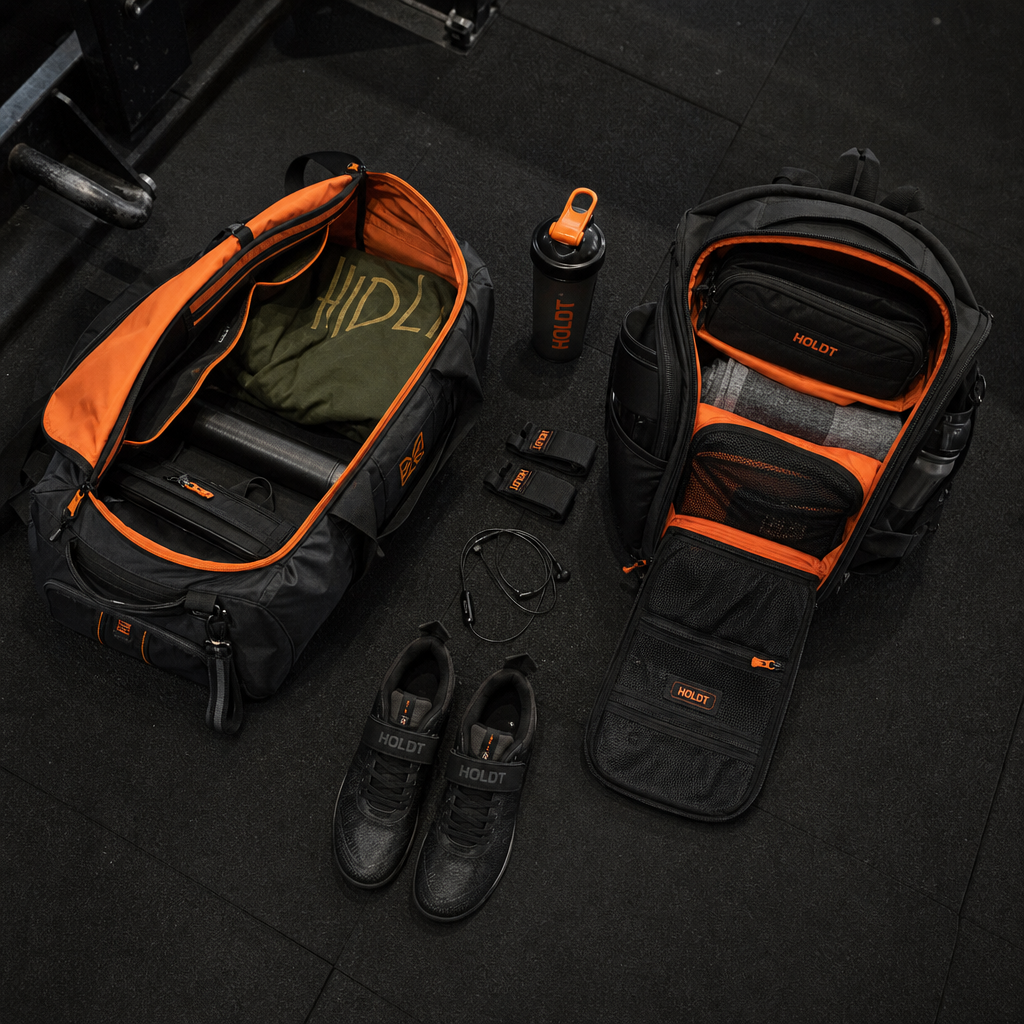
Most Australians do not drive straight from home to the gym and back again. The reality is a train from Parramatta, a tram across the CBD, a bike ride along the Yarra, or a walk from the office car park at 6:15am before the day kicks off. The bag you carry is doing double, sometimes triple, duty: work gear in, gym gear out, everything in between. That context makes the gym bag versus backpack question genuinely important, not just a style preference.
Here is the honest answer most comparison articles avoid: neither a duffel nor a backpack automatically wins. The right choice depends on your commute, your training style, how much you actually carry, and whether you want a bag that is purpose-built or one you are pressing into service because it was already in the cupboard. I have watched thousands of gym-goers make this decision. The ones who get it right are the ones who stop asking "which looks better" and start asking "which solves my actual problems".
This guide cuts through the noise. We will compare duffel-style gym bags and backpacks across every metric that matters to an Australian gym-goer in 2026: carrying comfort, capacity and access, commute suitability, organisation, hygiene, work-to-gym versatility, and durability. By the end, you will know exactly which format suits your training life and what to look for when you buy.
Key Takeaways
- Backpacks distribute load evenly across both shoulders, making them the better commute companion for public transport and cycling.
- Duffel bags offer superior top-access and larger single-compartment capacity, which suits gym-only trips or driving commutes.
- Shoe compartments and wet/dry separation are the two features most gym-goers undervalue until they do not have them.
- Most gym-goers do not need a 40L bag. A right-sized bag reduces friction and stops you carrying gear that does not improve your training.
- Work-to-gym versatility is where backpacks win consistently, especially in Australian city environments where professional appearance matters on the commute.
- The bag question and the storage question are not the same question. Where your bag lives between sets is a separate problem that neither format solves on its own.
Quick Comparison: Gym Bag vs Backpack at a Glance
| Criteria | Duffel Bag | Backpack |
|---|---|---|
| Carrying comfort (long commute) | Fair (single shoulder or hand carry) | Excellent (balanced two-shoulder load) |
| Capacity for large hauls | Excellent (20L-50L+) | Good (15L-35L typical) |
| Top/wide-mouth access | Excellent | Fair (zip-down panels help) |
| Cycling suitability | Poor (handlebar interference) | Excellent |
| Public transport suitability | Good (held at side) | Excellent (wearable, hands-free) |
| Dedicated shoe compartment | Common (base compartment) | Available but less common |
| Wet/dry separation | Varies by model | Varies by model |
| Work-to-gym versatility | Limited (casual appearance) | Strong (professional crossover) |
| Organisation (multiple pockets) | Limited on basic models | Strong on purpose-built models |
| Durability in Australian conditions | Strong if base-reinforced | Strong if base-reinforced |
| Floor hygiene risk | High (base always on floor) | Low (worn on back, set on back) |
| Price range (AUD) | $40-$300+ | $60-$350+ |
Carrying Comfort: Single Shoulder vs Balanced Load
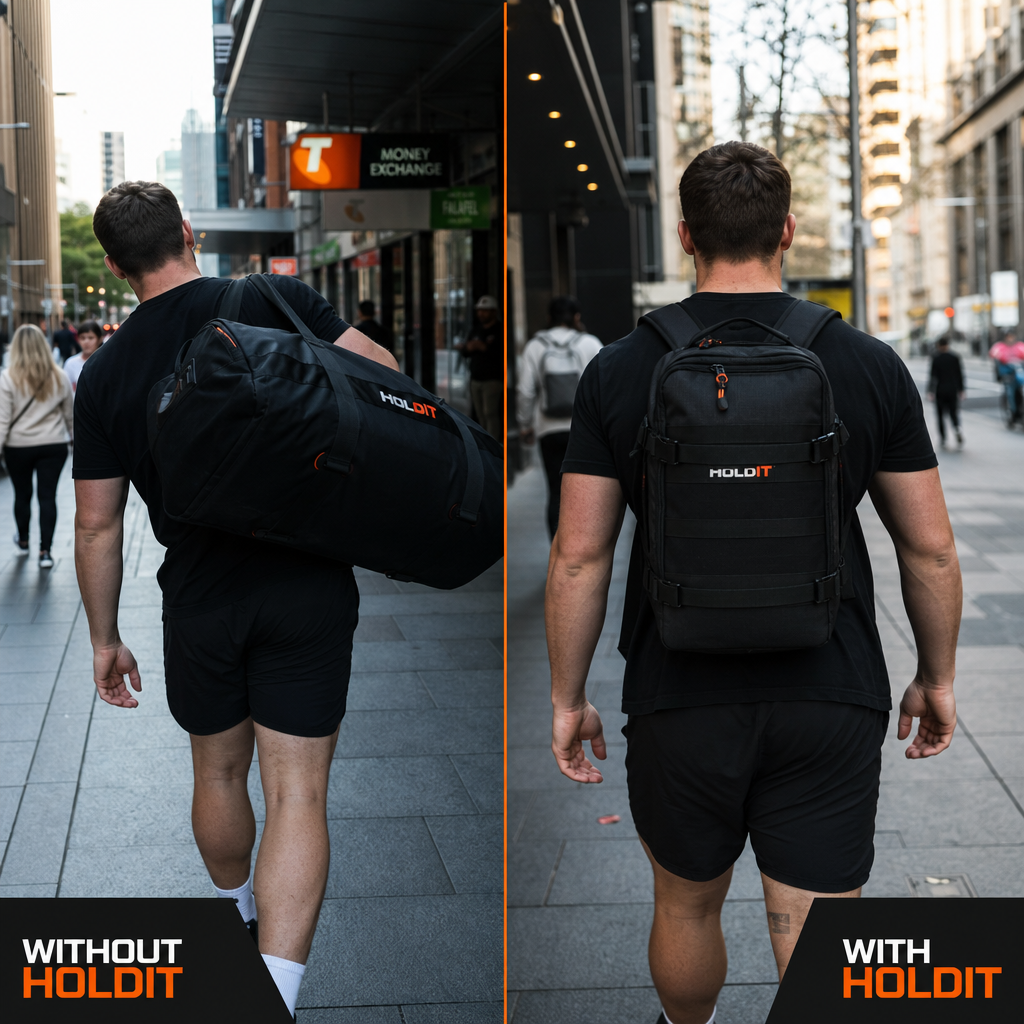
Let us start with the physical reality of carrying a bag in an Australian city. Whether you are walking from Central Station to your gym in Surry Hills, crossing the Princes Bridge in Melbourne, or cycling along the bike lanes on Frome Road in Adelaide, your bag is on your body for a significant chunk of your day.
The duffel shoulder problem
A duffel bag almost always comes down to one of three carry modes: over one shoulder, in one hand, or across the body on a crossbody strap if the model includes one. The over-shoulder carry is the most common, and it is also the most damaging over distance. Carrying 8-12kg on one shoulder for a 20-minute walk from the office to the gym produces measurable asymmetrical loading on your spine and shoulder. This is not catastrophic for the occasional trip, but for someone training four or five times a week, that cumulative load adds up across a year.
The crossbody option on a duffel is better than pure single-shoulder, but most duffel crossbody straps are thin and not padded for long carries. The strap digs in. You end up switching sides every few minutes, which is its own kind of irritation.
Why backpacks win the commute
A backpack distributes weight across both shoulders and, on a well-designed model with a sternum strap, across the chest. For someone cycling to the gym, there is no contest: a backpack keeps your hands free and your load centred. On a packed peak-hour train from Chatswood or Box Hill, a backpack worn on your front keeps you from swinging a duffel into other passengers every time the carriage jolts.
The ergonomic advantage of a backpack is not just comfort. It is also fatigue management. If you are training at lunch or after work, arriving at the gym with one shoulder already aching from carrying a duffel is not ideal preparation. You want to start your session fresh, not already compensating for asymmetrical load.
The verdict on carrying comfort
Backpacks win for commutes longer than 10-15 minutes on foot or any commute involving a bike. Duffels are fine if you are driving directly to the gym and the bag goes from car boot to gym floor. That difference matters because most Australians in major cities are not driving directly to the gym. According to the ABS Journey to Work data, public transport and active travel account for a growing share of commutes in Sydney, Melbourne, Brisbane, and Perth, particularly for inner-city workers. Your bag needs to work with that commute, not against it.
Capacity and Access: How Much Do You Actually Need?
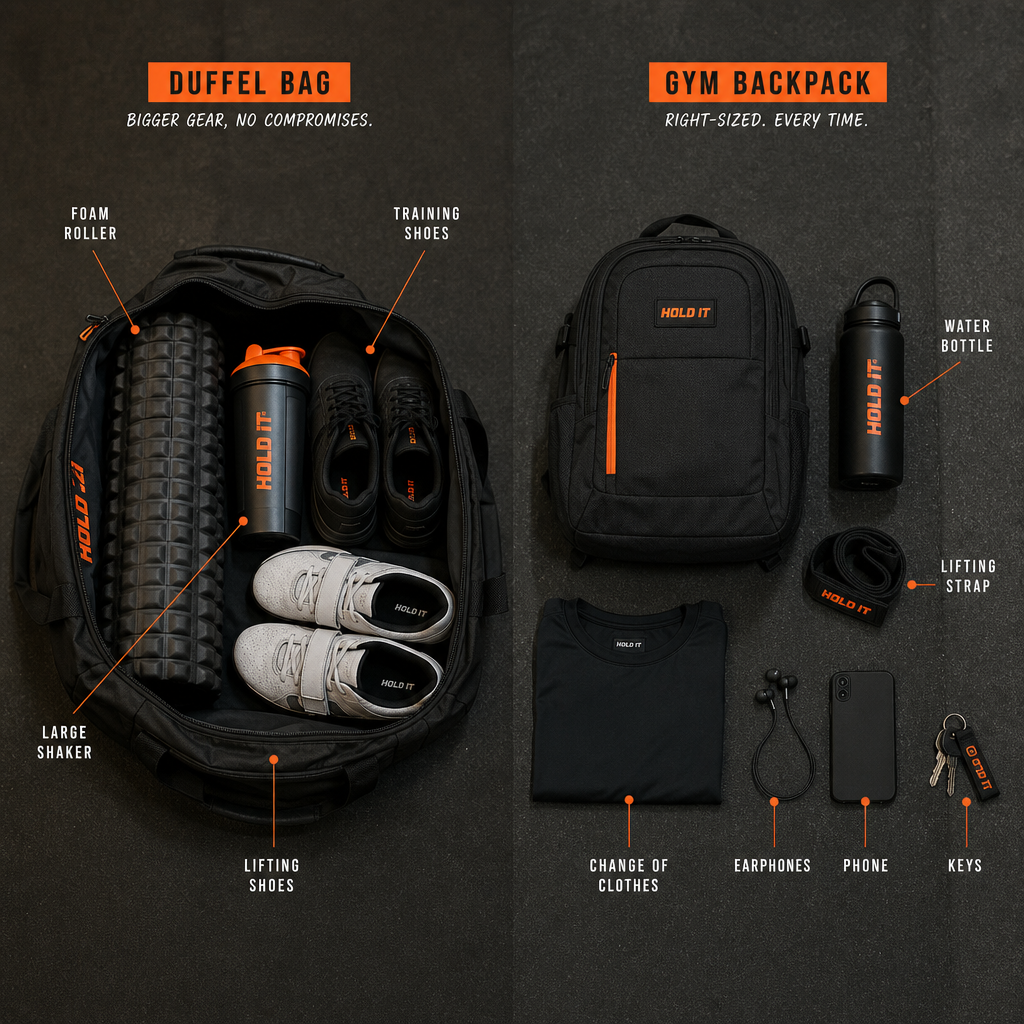
Here is the position I hold that most gear reviews will not say directly: most gym-goers do not need a 40L duffel. They need their phone, keys, wallet, earphones, a water bottle, and maybe some lifting accessories like straps, a belt, or chalk. That is 10-15L of actual gear. The rest of the space in an oversized bag gets filled with things that do not improve training, and a heavier bag creates more friction, not less.
The capacity question is really two questions: how much do you carry to the gym, and how much do you carry to and from work on the same trip?
Duffel capacity: the case for wide-mouth access
Where duffels genuinely shine is access. A wide-mouth zip along the top of a duffel opens the entire bag in one motion. You can see everything at once. There is no routing around a main compartment lid or fishing past a laptop sleeve to find your lifting belt. For gear that is chunky, oddly shaped, or bulky (think foam rollers, large shakers, recovery tools), a duffel is simply easier to pack and unpack.
Duffels also scale well. A 30L duffel sits flatter and lighter when half-full than a 30L backpack does. If your gear volume fluctuates between sessions, a duffel accommodates that variation more gracefully.
Backpack capacity: organised but bounded
A purpose-built gym backpack in the 20-30L range is right-sized for most Australian gym-goers who are also commuting. You get enough room for a change of clothes, a towel, a water bottle, and your accessories without lugging excess space. The internal organisation of a good gym backpack, multiple pockets, a dedicated wet pocket, a phone pocket with cable pass-through, means everything has a place and you spend less time searching between sets.
The limitation is access to large items. A laptop or large shaker can crowd a backpack main compartment quickly. If you carry a 2L water bottle plus a laptop plus gym clothes, you will feel the squeeze in anything under 28L.
The right-sizing principle
Before you decide on format, write a list of everything you actually carry to a typical training session. Be specific. If that list fills 15L, do not buy a 35L bag because it felt spacious in the store. A right-sized bag means less rummaging, less weight, and less of that sinking feeling when you realise you have packed for three sessions when you only needed gear for one. For more detail on choosing the right volume, the HoldIT Bag size guide for Australia walks through exactly this calculation.
Commute Suitability: Cycling, Public Transport, and the Australian City Context
Australia's major cities have invested significantly in cycling infrastructure over the past decade. Sydney's Harbour Bridge cycleway, Melbourne's Capital City Trail, Brisbane's Riverwalk, and Perth's network of off-road paths mean that bike commuting to the gym is a real, growing option. This has direct implications for bag choice.
Cycling with a gym bag
Carrying a duffel on a bike is a miserable experience. A crossbody duffel swings forward when you lean over the bars, shifts your centre of gravity unpredictably, and makes shoulder-checking dangerous. A pannier or basket is the proper solution for a cycling commute, but most gym bags are not designed to clip onto a rack. If you are cycling to the gym, a backpack is the practical answer, full stop.
The key is fit and ventilation. A backpack that sits flush against your back without excessive bounce is better than one that rides high and wobbles. Look for a sternum strap to prevent lateral shift, and a back panel with some airflow so you are not arriving at the gym completely drenched before you have even started training.
Public transport realities
On a crowded morning train or tram, a backpack worn on your front is the socially accepted and physically practical choice. You take up less space, your hands are free to grip the overhead rail, and you are not swinging a duffel into the person standing next to you every time the train decelerates from Central to Wynyard.
For shorter trips or off-peak travel, a duffel carried at your side is manageable. But for peak-hour commuting in Sydney, Melbourne, Brisbane, or any other Australian capital, the backpack's wearability is a genuine advantage.
Driving commuters: where the duffel reclaims ground
If you drive to the gym, the duffel becomes competitive again. The bag goes in the boot, comes out at the gym, and sits wherever you put it. You do not need to wear it. The access advantage of a wide-mouth duffel is fully realised without the carrying disadvantage. If your gym commute is door-to-door by car, a well-organised duffel with a shoe compartment and wet pocket is a reasonable choice.
Organisation, Shoe Compartments, and the Features That Actually Matter
Organisation is where most gym bags, duffel or backpack, fall down. Basic models give you one large compartment and maybe a small exterior zip pocket. That is not enough for a session that involves gym clothes, work clothes, shoes, a towel, a water bottle, earphones, a phone, keys, and any training accessories.
The shoe compartment question
Dedicated shoe compartments are almost universally found in duffel-style gym bags, usually as a base compartment accessible through a separate zip. This is genuinely useful. Your dirty trainers go in their own isolated space, not touching your clean work clothes or your towel. You do not need to bag your shoes separately or hope the smell dissipates before Monday morning.
Backpacks with shoe compartments exist, but they are less common and often smaller in base volume. If shoe storage is a priority for you, a duffel has the structural advantage: the wide, flat base is the natural home for a separated shoe compartment.
Wet/dry separation
This is the feature most people overlook until they pull a damp training shirt out of the same compartment as their laptop. Wet/dry separation means a dedicated waterproof-lined pocket for sweaty gear or wet bathers, completely isolated from dry contents. Some bags call this a "wet pocket" or "sweat compartment". It is not a luxury. For anyone doing a gym session and then returning to an office or public space, it is basic hygiene infrastructure.
Both duffels and backpacks can include this feature, but it is worth specifically checking for it rather than assuming it is there. A gym bag without wet/dry separation is an incomplete product for the commuter market.
Pockets and access points
For commuters moving between different contexts during the day, quick-access pockets matter. A front zip pocket for your phone, Opal card, or credit card means you are not digging through the main compartment at the ticket gate or the cafe counter. A side water bottle pocket keeps your hydration accessible without opening the main bag. An internal sleeve for a laptop or tablet is essential if the bag is doubling as your work bag.
Backpacks are structurally better suited to multiple access points because the form factor allows pockets on the front face, both sides, and the top. Duffels with serious organisation exist, but they tend to be at the higher end of the price range.
Sweat, Hygiene, and Bag Management in the Australian Climate
Australia's climate adds a dimension to bag hygiene that most international reviews do not address. Training in Brisbane or Darwin during summer means your gear is sweating before you have finished your warm-up. A 35-degree day in western Sydney in January means your bag is sitting in heat whether it is in your car boot, on the gym floor, or propped against a locker room wall.
Floor hygiene: the problem nobody talks about
Every conventional bag, duffel or backpack, sits on the floor at some point during a gym session. Gym floors accumulate chalk, sweat, bacteria, and general grime at a rate that most regular gym-goers choose not to think about too carefully. Your bag base picks up whatever is on the floor and transports it to your car, your home, your office.
This is where the bag format question intersects with a separate but important question: where does your bag live between sets? A duffel on the floor is picking up floor contamination for the full duration of your session. A backpack leaning against the squat rack is doing the same thing on one panel. Neither format has an architectural solution to this problem.
The solution, for anyone who takes training hygiene seriously, is to keep the bag elevated. A magnetic bag hook that snaps onto any metal upright keeps your bag off the floor without requiring fixed gym infrastructure. It works on cable machine uprights, rack frames, dumbbell rack rails, and anywhere else there is a vertical metal surface. The magnet holds up to 4kg, which covers everything a right-sized gym bag should contain.
I started recommending this setup after noticing how often training sessions got interrupted by the simple act of tracking down a bag that had slid off a bench or been kicked across the floor during a busy session. Once the bag is at eye level and within arm's reach, that interruption disappears.
Sweat-wicking bag materials in Australian conditions
For Australian gym-goers, look for bag materials that do not trap moisture or develop odour quickly. Woven nylon and polyester with antimicrobial treatment are the practical choices. Avoid bags with a large surface area of non-breathable PVC-coated fabric as the primary material because they trap heat and accelerate bacterial growth in warm conditions.
Base reinforcement is worth prioritising regardless of format. A reinforced base that is easy to wipe down or is constructed from material that does not absorb floor moisture is a genuine durability feature in a country where gyms are air-conditioned but gym floors are not always pristine.
Work-to-Gym Versatility: The Australian Office Context
The work-to-gym trip is one of the most common use cases for gym bags in Australian cities. You leave home in work clothes, gym gear packed, commute to the office, train at lunch or after work, and then either head home or return to the office. The bag needs to look acceptable in both environments.
Backpacks in the professional context
A clean, structured backpack in a neutral colour reads as professional in most Australian workplaces. Technology companies, creative agencies, and even corporate environments in Sydney and Melbourne have normalised the backpack as an everyday work accessory. A well-designed gym backpack can pass as a work bag without anyone questioning it.
This crossover function has real value. It means you carry one bag instead of two, which reduces the cognitive load of switching between contexts and eliminates the risk of leaving your gym bag at home when you planned to train after work.
Duffels in the professional context
A duffel is recognisably a sports bag. That is fine in many contexts, but it does not blend into a professional environment the same way a backpack does. If your role involves client-facing work or you work in a more formal industry (finance, law, healthcare), carrying a duffel through reception is a different signal than carrying a structured backpack.
There are premium duffel options that approach a more refined aesthetic, but even the best duffel still reads as athletic gear rather than professional equipment. If work-to-gym versatility is a priority, the backpack is the more adaptable format.
Durability in Australian Conditions: What to Look For
Australian conditions are hard on gear. UV exposure, heat, red dust in regional areas, and the general intensity of outdoor commuting in a warm climate accelerate wear on bag materials and hardware.
Hardware: zips and buckles
Zip failure is the most common way a gym bag dies. Look for YKK or equivalent quality zips on any bag you intend to use four or five times a week. Coil zips tolerate more abuse than stamped tooth zips on high-stress openings like the main compartment. Metal zipper pulls are more durable than moulded plastic pulls, which become brittle in heat and UV exposure.
Buckle hardware on shoulder straps and compression straps should be solid plastic (Duraflex or equivalent) or metal. Cheap hollow buckles crack with repeated use, particularly in cold winter mornings followed by warm gym environments.
Base durability
The base of a gym bag takes more punishment than any other surface. It sits on gym floors, car boots, bike racks, and concrete. A reinforced base, whether from a separate moulded panel, heavier denier fabric, or rubberised coating, is worth paying a premium for. A bag that loses its base integrity after 12 months is not a cost saving; it is a replacement cycle.
Seam construction
Flat-felled seams (where the seam allowance is folded and stitched down) are more durable than simple sewn seams under load. On a gym bag that is regularly packed close to capacity, seam quality determines lifespan. Bags that use bartacking at stress points (strap attachments, pocket corners, handle bases) last significantly longer than those relying on standard lockstitch alone.
Real-World Case Studies: What the Data Shows
Case study 1: The commuter who lost 5-10 minutes per session
I work with a gym member training four to five sessions per week at a commercial gym in Sydney's inner west. Every session, they were leaving their bag on the floor near the free weight area or balancing it on a bench where it would slide off mid-set. The bag was a standard 30L duffel with decent organisation but no solution to the floor problem. They were losing 5-10 minutes per session searching for their phone, retrieving their bag from the floor, and dealing with the mental interruption of worrying about their gear between sets.
The fix was not buying a new bag. It was attaching a HoldIt magnetic bag hook to the upright of the cable machine nearest to where they trained. Within the first session, the bag was elevated, within arm's reach, and stayed there for the whole session. Distractions between sets dropped immediately. Across a five-session week, they estimated reclaiming 25-50 minutes of focused training time. The format of the bag, duffel versus backpack, was not the issue. The storage solution was.
Case study 2: No fixed hooks, no problem
A member at a larger commercial gym noticed that the free weight area had no dedicated bag storage. Members were piling duffels and backpacks along the walls and on benches, creating a genuine trip hazard near the plate storage and causing friction when someone needed to use a bench that had become a bag shelf.
They brought a HoldIt bag hook to every session and clipped it onto whatever vertical metal surface was available nearest to their working station. Rack uprights, cable tower frames, dumbbell rack rails. The magnet held consistently. Their gear stayed off the floor across every zone of the gym without needing to ask management to install fixed hooks. One hook, portable, covered every station in their session.
This matters to the bag format question because it illustrates that neither a duffel nor a backpack solves the floor storage problem on its own. The hook is the missing variable that makes either bag format work properly in a real gym environment.
Which Format Wins in Which Scenario?
Let me be direct about the scenarios rather than hedging.
Choose a backpack if:
- You commute by bike, on foot for more than 10 minutes, or on public transport.
- Your gym is close to your workplace and you are carrying both work and gym gear.
- You need the bag to look appropriate in a professional environment.
- You are training in a gym where locker space is limited and you keep the bag with you.
- You prefer hands-free carrying during transit.
Choose a duffel if:
- You drive directly to the gym and back.
- You carry bulky items like foam rollers, large shakers, or multiple pairs of shoes.
- You change gear volumes frequently between sessions.
- Wide-mouth quick access to all your gear is more important than external organisation.
- You train at a facility with good locker infrastructure and do not carry the bag through the session.
In both cases:
- Prioritise a wet/dry separation pocket.
- Check for a dedicated shoe compartment or plan a separate shoe bag.
- Right-size the bag to what you actually carry, not what you might carry.
- Solve the floor storage problem separately with a portable hook solution.
For a detailed breakdown of sizing by training type and load, the HoldIT Bag gym bag size guide covers the volume question specifically for Australian conditions and training styles.
What 10,000+ Gym-Goers Have Taught Us
With more than 10,000 members in the HoldIt crew and an average verified review rating of 4.8 out of 5 across 895+ reviews, we have seen the full range of gym bag setups. The pattern is consistent: people over-invest in bag volume and under-invest in bag organisation and storage solutions.
The most common feedback we get from customers who have sorted their gym setup is that they wish they had made the change earlier. Not because the products are magic, but because having a system that actually works, bag elevated, gear within arm's reach, phone never lost, keys always in the same pocket, removes a category of friction that most gym-goers have simply accepted as part of training. It is not part of training. It is a solvable problem.
As one regular customer put it: "I used to spend the first few minutes of every session just sorting out where to put my stuff. Now it is sorted before the first set. I did not realise how much mental energy that was costing me until it stopped."
The bag format matters. But the storage solution matters just as much. Neither a premium duffel nor a premium backpack keeps your gear off the floor, within arm's reach, and your bench clear between sets. For that, you need something that snaps onto your station and holds everything where you can see it. The HoldIT Bag shop has both the bag solutions and the accessories designed to make the whole system work together.
A Note on Price and Value in the Australian Market
The Australian market for gym bags ranges from $40 fast-fashion versions that last six months to $300+ technical products from established brands. The sweet spot for a purpose-built gym commuter bag in 2026 sits in the $80-$180 AUD range. At that price point, you are getting quality zips, proper base reinforcement, and the organisational features (wet pocket, shoe compartment, multiple access points) that make the bag worth carrying every day.
Below $60, you are usually compromising on zip quality, seam construction, or base durability. Above $200, you are often paying for brand premium rather than functional improvement. For a bag that is doing four to five sessions a week on a commuting lifestyle, the $80-$150 range is where most gym-goers will find the best cost-per-use outcome.
GST applies to all bag purchases in Australia. If you are buying from an overseas retailer and the purchase is over $1,000 AUD, GST and import duties apply at the border. For most gym bag purchases, buying from an Australian retailer means GST included in the price and no duty surprises.
Putting It All Together: The Practical Setup for Australian Gym-Goers
The ideal gym kit in 2026 is not just about picking the right bag format. It is about thinking through the full system: how you get to the gym, what you carry, how your bag is stored during your session, and how you transition between gym and work or home.
For most Australian city gym-goers, that means:
- A 20-28L backpack with dedicated wet pocket, shoe compartment, and professional-enough aesthetic for the commute.
- A portable magnetic bag hook that keeps the bag elevated and within arm's reach at any station in the gym.
- A packing system that is right-sized to what you actually need, not what you might need.
For gym-goers who drive, train with heavier accessories, or prefer the access advantages of a wide-mouth design:
- A 25-35L duffel with base shoe compartment, wet pocket, and reinforced base.
- The same portable hook solution for in-session storage.
- A right-sized packing approach.
If you are unsure which format suits your specific training setup, reach out to the HoldIT team and we will sort it for you. Every order is dispatched from Sydney within 48 hours, so you are not waiting weeks for the right solution.
References
-
Australian Bureau of Statistics, Journey to Work data (2026 census cycle): The ABS Journey to Work dataset tracks commuting methods across Australian capital cities, including public transport, cycling, and walking shares by suburb. Used to contextualise commute patterns for Australian gym-goers choosing between bag formats.
-
Standards Australia, AS/NZS ergonomic guidelines for load carriage: Standards Australia publishes guidelines on recommended load limits and carry methods for prolonged walking and commuting, relevant to the shoulder-load discussion in the carrying comfort section.
-
Australian Competition and Consumer Commission (ACCC), Consumer product durability standards: The ACCC enforces Australian Consumer Law requirements around product durability and fitness for purpose, providing the regulatory framework for assessing whether a gym bag meets reasonable lifespan expectations under regular use.
-
HoldIT Bag verified customer review data (2026): Internal aggregated data from 895+ verified customer reviews, with an average rating of 4.8 out of 5. Used for customer sentiment data and first-hand usage pattern observations cited in the case study sections.
-
YKK Group, technical product documentation on zip construction and durability ratings: YKK is the world's largest zip manufacturer. Their published technical documentation on coil versus stamped tooth zips and durability testing was used to inform the hardware durability section.
-
Sports Medicine Australia, position statement on asymmetrical load carriage and musculoskeletal risk: Sports Medicine Australia's position statements on load carriage address the cumulative musculoskeletal risk of repeated asymmetrical shoulder loading, relevant to the single-shoulder duffel carry discussion.
Get exclusive training tips & early access
Join 5,000+ athletes who train smarter.
Frequently Asked Questions
Is a backpack or duffel bag better for commuting to the gym in Australia?
For most Australian city commuters, a backpack is the better choice. It distributes weight evenly across both shoulders, keeps your hands free on public transport, and is the only practical option for bike commuting. A duffel is competitive if you drive directly to the gym, because the carrying disadvantage disappears when the bag goes from car to gym without a long transit leg.
How much capacity do I actually need in a gym bag?
Most gym-goers need between 15L and 25L. That covers a change of clothes, a towel, shoes in a separate compartment, a water bottle, and small accessories like earphones, a phone, and keys. If you are also carrying work gear (laptop, documents, a change of professional clothing), a 25-30L bag covers the combined load. A 40L+ bag is overkill for most people and encourages packing gear that does not improve training.
What should I look for in a gym bag if I cycle to the gym?
For cycling commuters, a backpack is the right format. Key features to look for: a sternum strap to prevent lateral movement on the bike, back panel ventilation to reduce sweat build-up, a hip belt for heavier loads, and reflective detailing for low-light riding. Weight matters more on a bike than on foot, so keep the bag and its contents as light as possible.
Do gym bags need a separate shoe compartment?
For most gym-goers, yes. A dedicated shoe compartment, usually a base-level zip-access section in a duffel or a lower compartment in a backpack, keeps dirty training shoes isolated from clean clothes, food, and electronics. Without one, you are either double-bagging your shoes in a separate bag (extra bulk) or mixing clean and dirty gear in the same space.
How do I manage sweat and hygiene in my gym bag?
The two key features are a wet/dry separation pocket and materials that do not trap moisture or odour. A waterproof-lined wet pocket keeps sweaty training gear isolated from everything else. After each session, remove damp gear promptly rather than leaving it sealed in the bag. Air the bag out between uses. Avoid leaving food in gym bags in warm conditions, particularly in Australian summers where car boot temperatures can exceed 60 degrees celsius.
Can I use a gym bag for work as well?
A backpack can function as both a gym bag and a work bag in most Australian professional environments. Look for a model with a padded laptop sleeve, professional-neutral colourways, and enough internal organisation to keep work items separate from gym gear. A duffel is harder to pass off as a work bag in formal environments, though premium duffel styles work in casual or creative workplaces.
What is the best way to store my bag during a gym session?
Keeping your bag off the floor is better hygiene and better training focus. A portable magnetic bag hook clamps onto any metal gym upright, including rack frames, cable towers, and dumbbell rack rails, holding up to 4kg. This keeps your gear elevated, within arm's reach, and off the high-traffic gym floor without requiring any fixed infrastructure or gym management involvement.
How much should I spend on a gym bag in Australia?
The practical sweet spot in 2026 is $80-$180 AUD for a purpose-built gym bag. In that range you get quality zips (YKK or equivalent), a reinforced base, and purpose-built features like wet pockets and shoe compartments. Below $60, durability becomes a concern for a four-to-five-sessions-per-week user. Above $200, you are often paying for brand positioning rather than additional functional value. All prices include GST when buying from an Australian retailer.
Related Articles
Gym Bag Compartments Explained: How to Choose a Bag That Keeps Everything Separated in Australia
What Size Gym Bag Do You Need? An Australian Guide to Choosing the Right Capacity
What to Wear to the Gym in Australia: A Complete Guide to Gym Clothing and Activewear
Your gear deserves better
Keep it clean, organised, and always within reach. The HoldIt bag system is built for athletes who take training seriously.